

Released in 2003 (v1.1). Not tested with current DAW software.
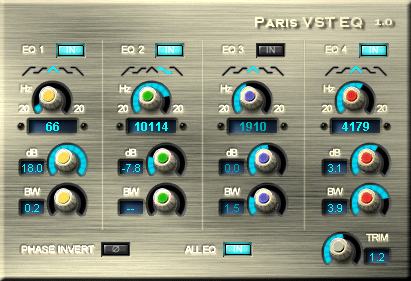
The Paris VST EQ is a Windows VST plug-in that recreates the four-band parametric EQ of the E-mu/Ensoniq PARIS recording system, which ran on custom DSP hardware. I ported the original algorithm to native code, so the EQ and its character (soft limiting, saturation and resonance) could run in any VST host rather than only on PARIS cards. PARIS owners also gained the same EQ on both native and DSP-card submixes.
Stack: C++, VST SDK, DSP · Download: ParisEQ11.zip (v1.1, Windows)
Porting the algorithm
Matching the hardware meant understanding the PARIS architecture and its signal flow at the bit level, and accurately modelling the relevant parts of the custom DSP’s multiply-accumulate (MAC) unit and ALU. That modelling is what makes the plug-in’s output virtually bit-identical to the original, including the quirks described below.
Accuracy
The goal was a faithful reproduction, quirks included:
- Soft limiting on the output
- EQ calculations fixed at the original’s 48 kHz sample rate
- Heavy distortion when the trim exceeds 12 dB with band 1 enabled at certain settings
- Resonance with the peaking type at very low Q, useful for adding weight to kick drums
- Output phase inversion when the trim exceeds 18 dB
- The original’s parameter smoothing, including the gliding resonance it produces on a high-boost, low-Q peaking band
Validation
In blind listening tests, testers couldn’t tell the plug-in from the original. With most settings the two cancel almost completely when one is phase-inverted and summed with the other.
I also used it on some of the instrument tracks for The Supernormal recordings.
Features
- Four fully parametric bands
- Filter type per band: high-pass, high-shelf, peaking, low-shelf or low-pass
- Cut/boost for shelving and peaking bands; bandwidth in octaves for peaking bands
- Output trim for level adjustment and saturation
- Phase invert and global EQ bypass
- 64-bit internal precision
- Windows only
Behaviour by design
A few behaviours that look like bugs are faithful to the original hardware.
Distortion with band 1 enabled and trim above 12 dB. The original implements the trim control using the first EQ band. With high trim and band 1 enabled, its filter coefficients overflow and distort, which can be useful for lo-fi effects.
Raising the trim can lower the output. For the same reason: with some band 1 settings, raising the trim from about 13 dB to 17 dB reduces the output level.
Phase invert has no effect above 18 dB of trim. Also caused by coefficient overflow.
Resonant settings cancel less well against the original. With the peaking type, high boost and very narrow bandwidth, both versions resonate but drift slightly out of phase. This is most likely because tiny rounding differences get amplified in the feedback loop that produces the resonance.
Credits
Thanks to Marc Girard, who did most of the interface graphics, and to Chuck Duffy, who obtained the original PARIS DSP source code from E-mu/Creative under agreement.